Learn More
*** ACO REACH is expected to end after PY 2026. ACO REACH will be replaced by new program model LEAD for PY 2027. ***
ACO REACH
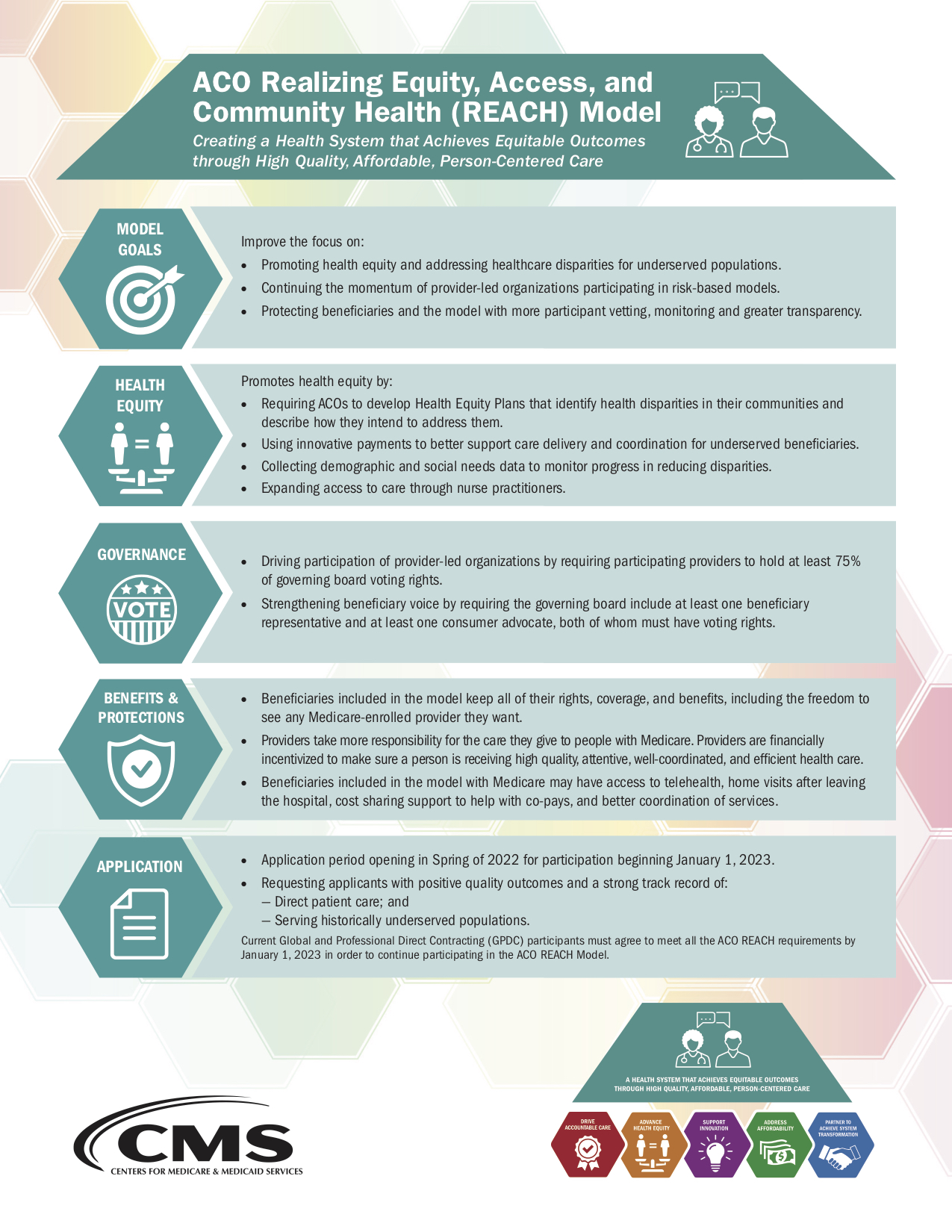
ACO REACH (Accountable Care Organization Realizing Equity, Access, and Community Health) is a Medicare model designed to enhance healthcare equity, provider accountability, and financial sustainability. It focuses on improving care for underserved communities while promoting value-based care through risk-sharing arrangements.
Key Features of ACO REACH
Advancing Health Equity
- ACOs must develop health equity plans to address disparities.
- Strategies include improving access to care and targeted interventions for vulnerable populations.
Provider Leadership & Governance
- 75% of the governing body must be controlled by participating providers.
- Requires at least two beneficiary advocates (one Medicare beneficiary and one consumer advocate) with voting rights.
Beneficiary Protection Measures
- Stricter oversight of ownership, leadership, and governance structures.
- Enhanced transparency and patient engagement initiatives.
Three types of Participants:
Standard ACOs
Standard ACOs are organizations that have experience serving Original Medicare patients. They have previously participated in another shared savings model and/or the Shared Savings Program. If you're a new organization, you must be composed of existing Original Medicare providers and suppliers. This is to ensure that any participating clinicians will have substantial experience serving Original Medicare Beneficiaries.
New Entrant ACOs
New Entrant ACOs are comprised of organizations that have not traditionally provided services to an Original Medicare population. They can also be organizations who may rely primarily on voluntary alignment in the first few performance years of model participation. Claims-based alignment is applied here.
High Needs Population ACOs
High Needs Population ACOs are ACOs that serve Original Medicare patients with complex needs, including dually eligible beneficiaries, who are aligned to an ACO through voluntary alignment or claims-based alignment.
-
- These participants are expected to use a model of care designed to serve individuals with complex needs, such as the one employed by the Programs of All-Inclusive Care for the Elderly (PACE), to coordinate care for their aligned beneficiaries
Participant Options:
Professional - Lower risk-sharing
50% savings/losses—with one payment option for participants:
- Primary Care Capitation Payment, a risk-adjusted monthly payment for primary care services provided by the ACO’s participating providers.
Global - Higher risk-sharing
100% savings/losses—with two payment options:
- Primary Care Capitation Payment (described above)
- Total Care Capitation Payment, a risk-adjusted monthly payment for all covered services, including specialty care, provided by the ACO’s participating providers.
Performance Year 2026 Adjustments
Risk Score Restraints
Standard ACOs
For PY 2026, after the application of the current Cap and CIF policy, CMS will apply an additional cap of 3% on risk score growth from 2019 to 2026 to constrain risk score growth from the early years of the model.
High Needs ACOs
In PY 2026, CMS will increase the ceiling on the CIF from 1% to 2% for High Needs ACOs. For newly voluntarily aligned beneficiaries in High Needs ACOs, CMS will apply an asymmetric risk score growth cap of 8% from 2023 to 2026. No minimum beneficiary threshold will apply to the newly voluntarily aligned risk score cap.
All ACOs:
In PY 2026, ACOs with a Beneficiary Population that is at least 3 times bigger than the Reference Year Population will no longer be exempt from risk score caps.
Reduce the regional component of the benchmark
In PY 2026, CMS will decrease the regional benchmark weighting for all REACH ACOs.
- For Standard ACOs: The weighting will change by 5%
- From 55%/45% blended historical and regional expenditures in PY 2024 and PY 2025 ---> 60%/40% in PY 2026.
- For New Entrant and High Needs ACOs: The weighting will change by 5%
- From 50%/50% blended historical and regional expenditures in PY 2025 ---> 55%/45% in PY 2026.
Narrow the 1st Risk Corridors for REACH ACOs in the Global risk option
In PY 2026, CMS will narrow the 1st risk corridor to be 10% (instead of 25%) for REACH ACOs in the Global risk option (100% risk), so that savings and losses above 10% are shared with CMS.
Increase Quality Withhold while proportionally increasing the High Performers Pool (HPP) Bonus
In PY 2026, CMS will increase the Quality Withhold from 2% to 5%, which will accordingly increase the HPP Bonus.
Update Risk Adjustment Model
In PY 2026, CMS will continue with implementation of the V28 model and increase the weight on the new V28 prospective HCC model to 100%. The concurrent risk adjustment model used for High Needs ACOs is not being modified.
Adjust PY 2024 Expenditures for Significant, Anomalous, and Highly Suspect (SAHS) Billing
ACO REACH will remove two HCPCS codes:
- A4353
- A5057
They are associated with intermittent urinary catheter supplies and ostomy bags that were identified for SAHS billing activity from 2024 expenditures and re-calculate the retrospective trend adjustment and stop loss.
These two HCPCS codes will be excluded from Performance Year expenditures and Retrospective Trend Adjustments for PY 2024 and from historical benchmark years for PY 2024, unlike with PY 2023 SAHS policy, where historical benchmark adjustments were not made for SAHS, and will be excluded from future performance years where 2024 serves as a benchmark year.
Beneficiary Engagement Incentive (BEI)
In PY 2026, a new Substance Access BEI will give model participants the option of consulting with their patients about the possible use of eligible hemp products.
- The implementation of this BEI and any related dispensing would be funded entirely at the participant’s expense; CMS would not cover the cost of such products.
- CMS will have strict program integrity safeguards to ensure that these incentives do not result in program or patient abuse.
- The Substance Access BEI is only available to participants in states where the eligible hemp products are considered legal.
ACO REACH Overview